
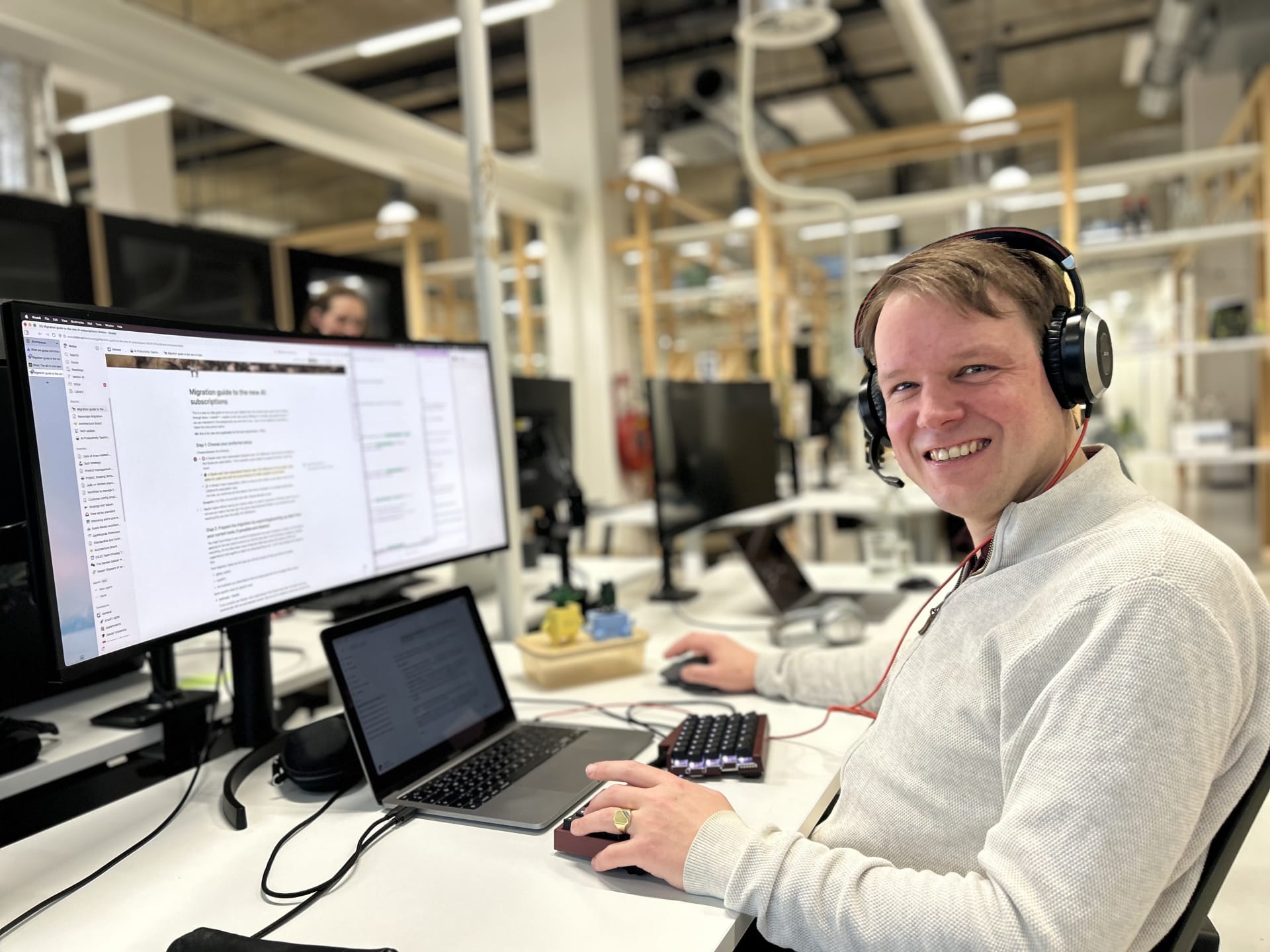
Gerben joined Dexter a little over two years ago after spending a decade working in the Norwegian power sector. After moving back to the Netherlands, he describes his transition to Dexter as a “match made in heaven.” Based near Utrecht, Gerben balances life as a staff engineer with family time—often spent building Lego creations or going geocaching with his two kids.
At Dexter, Gerben is the company’s only Staff Engineer. His role is to identify and solve broad technical challenges that cut across teams. From leading organization-wide technical initiatives to writing design documents and aligning stakeholders, he operates at the intersection of architecture, strategy, and execution. Most recently, he has been leading Dexter’s efforts to define and adopt AI-driven workflows across the company.
Gerben, what does being a Staff Engineer at Dexter look like in practice?
“My role is about stepping back and asking: what are the biggest technical challenges we need to solve as a company? It’s less about optimizing one component and more about improving the system as a whole.
That means I still write code, but I also spend a lot of time drafting design documents, building consensus, and talking to teams across the organization. For example, right now I’m helping define how we adopt AI workflows in a way that actually works for Dexter—not just as an experiment, but as something embedded in how we operate. It’s about connecting dots across teams and making sure we’re solving the right problems.”
You previously led Dexter’s expansion into the intraday markets. What made that project so significant? “When I joined, Dexter was primarily focused on day-ahead trade optimization. About a year and a half ago, I took on the role of tech lead for a new initiative: extending our services into the intraday markets.
This was a major step. As renewable energy trading increasingly shifts from day-ahead to intraday, being active in intraday markets became critical for ensuring the profitability of wind and solar assets. It wasn’t just an incremental feature—it required us to fundamentally rethink parts of our existing processes.
Technically, it was a deep and challenging project. We had to combine strong engineering with a solid understanding of power market dynamics. It was exactly the kind of work I enjoy: complex, meaningful, and closely tied to real-world impact for our clients.”
What did you learn from leading that initiative? “There were three big learnings for me.
First, people management. We worked with a small team, and my focus was on making sure everyone could operate from their strengths. Getting that right makes all the difference in both speed and quality.
Second, I gained a lot of domain knowledge about the intraday power market. It was new territory for us, and diving into it expanded my understanding of how these markets function in practice.
Third, and maybe most importantly, we struggled to reach product-market fit after the initial technical build. We didn’t have a dedicated product manager throughout the entire process, and as a company we were re-learning how to launch a new initiative in that way. It was a bit of a bumpy ride, but it forced us to listen closely to customers, gather feedback quickly, and evolve the product based on real needs. That experience has been incredibly valuable for how we approach new initiatives today.”
What would you tell engineers considering Dexter? “Be explicit about why you care about this domain. At Dexter, we’re a tight-knit group of people who genuinely care about contributing to a renewable future.
Technical excellence is important, of course—but so is motivation. If you’re passionate about building systems that enable renewable energy to scale profitably, that really resonates here. It’s a place where you can work on hard technical problems and know that they directly support the energy transition.”